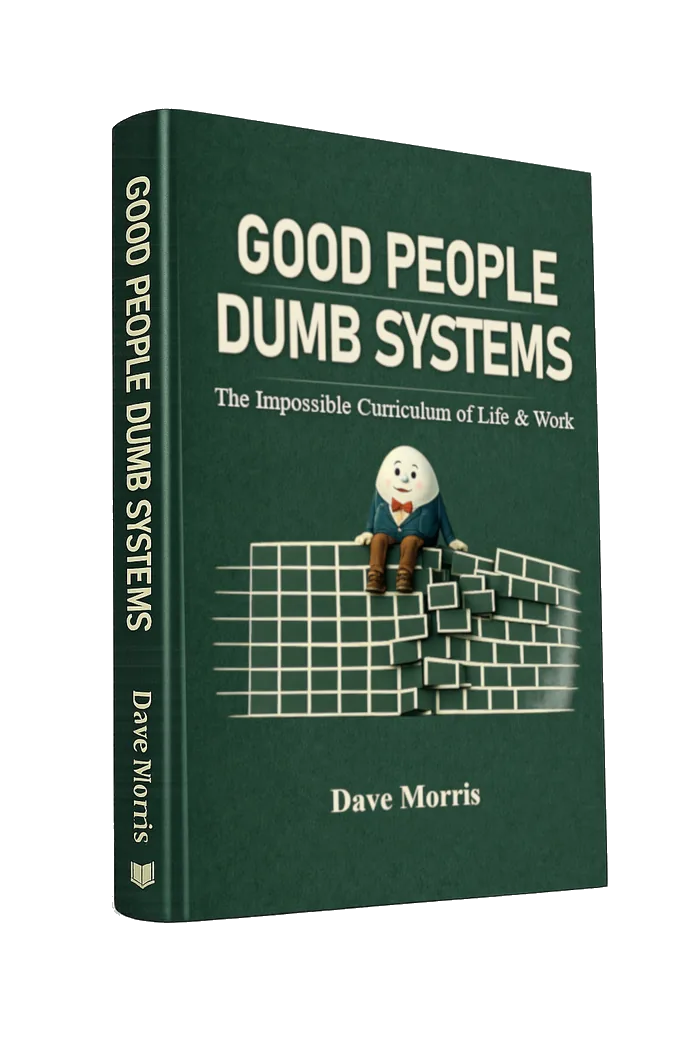
Good People Dumb Systems book

The book · Dave Morris

Good People,
Dumb Systems

The Impossible Curriculum of Life & Work

Life and work ask us to keep up, stay available, and get everything right. What happens when those demands stop fitting the people carrying them?

Free book preview

Read Chapter 1.

How to Be a Good Adult · Read the complete first chapter, search it, or download the PDF.

Download Chapter 1 PDF

Good People Dumb Systems · Page 6

Chapter 1: How to Be a Good Adult

Life and work aren’t supposed to feel like constant catch-up. If it does, you’re not broken. You’re responding normally to a system that’s expensive for a human nervous system. You’re living in a world that taxes your brain with hidden costs and leaves you running a lower-performance model most days. Once you’re in overdraft, you’re borrowing from tomorrow. On a normal day, doing normal things, you can be put into overdraft before lunch. Over time, overdraft doesn’t just make you slip. It changes your defaults. Those settings decide who you are. They decide what gets noticed, what feels urgent, what gets ignored, what gets assumed, and what happens under pressure. They decide what you’re capable of. At first it feels like a slip. A page you read twice. A team that won’t click. A strategy with moving targets. That’s your brain, choosing the cheap move instead of the best move, taking a shortcut that didn’t work out. When the day keeps forcing the cheapest move, your brain gets better at the cheap move and worse at the others. That reduces the things you do. It reduces what you’re capable of. Over time, that becomes capability rot: a slow narrowing of what’s affordable — judgment, skill, creativity, range. One person slipping looks like a bad day. Two people slipping looks like a coordination problem. A hundred look like a bad plan. A few billion look like a panicked world.

Good People Dumb Systems · Page 7

Everything feels urgent. Everyone feels behind. It gets busy. It gets loud. It gets reactive. We start selecting for confidence over accuracy because confidence is cheaper. In the end the loudest voices, and not the best ideas, end up winning. A system in chronic overdraft spends its budget on keeping up. It stops paying for maintenance, learning, prevention, and repair. It stops doing the work that makes tomorrow easier than today. At the personal level, recovery keeps getting postponed until the body forces a stop. The range of what you can do without breaking gets narrower. You start living inside the cheapest version of yourself. Not because you chose it, but because it’s all that’s affordable. At the team level, coordination becomes the work. Strategy keeps getting delayed because there’s never enough budget left for slow thinking. Every surprise becomes an incident. At the ecosystem level, everything runs closer to the edge. Small bumps turn into crises. Updating gets harder. Repair gets postponed. The future gets thinner, because the system stops doing the things that create options. It’s the same loop repeated from the individual to the world. At every level you end up with personal and shared systems running at their limits constantly, wearing down over time until they finally break. That’s the end state. Not chaos. Not one bad week. A steady downgrade that keeps compounding. This is happening because we keep ignoring human limits and differences. Same mechanism. Same budget. Same tax. Bigger blast radius. You can feel it in your day.

Good People Dumb Systems · Page 8

People stop solving problems they used to solve and come to you for things they should be able to handle themselves. A decision that should have been made a month ago gets pushed again. Deadlines that should be simple go soft. Work stays half-finished. Projects drift off-track, then they get abandoned without being properly closed. Everything still looks fine from a distance, but it’s already starting to rot. Go inside your brain and the reason we lose capability gets a little clearer. In some lab studies, sustained high-cognitive-demand work can lead to changes in brain chemistry. As we work, glutamate builds up in the prefrontal cortex. Glutamate is the brain’s main excitatory neurotransmitter. It’s how neurons make other neurons move. Eventually, your brain starts making different choices. Things haven’t gotten any harder, but they have become more expensive to run, and you only have a limited budget. Because your brain’s a cheapskate, it prefers the cheap move even when the better move is still available. That can’t be overcome with mindset. It’s a physical limit on your behavior. More high-demand work means more use of the bandwidth budget and before you know it, you’re running on the edge permanently. Even when things are going well, you’re one shock away from disaster. If we follow this flow to the extreme edges of the map, lab studies show us the end of the road. When glutamate is pushed far past normal limits, neurons can become overactivated and kick off a cascade of stress and damage. In extreme cases found outside the workplace, cells can be injured and die, causing major brain damage. This is not the claim made about everyday life and work. This is the boundary condition — the edge that shows what happens when limits are ignored for too long. It shows the final failure mode of where things could go to in an extreme scenario.

Good People Dumb Systems · Page 9

The protected claim is simpler. If the environment keeps getting more extreme, and recovery keeps getting more expensive, then more of our time gets spent closer to the edge of our biological limits. When you live closer to limits, shocks hit harder. And breakdown stops being a rare event and starts becoming the predictable start of a chain reaction in an overspent system. And if those downgrades keep coming, the future gets narrower. Not in theory. In options removed and moves you can’t make. You end up less capable, and so do the people around you. And it all happens on a normal day. In most environments, you’ll feel your brain start to drift somewhere between late morning and late afternoon. Those limits aren’t a moral flaw. They’re the human design spec. They’re signals about how we’re put together. When they show up, they aren’t proof you’re failing at life. They’re proof you are a living, breathing, thinking human. There are good reasons we evolved this way. The same systems that make you distractible in a noisy office are the systems that keep you alive in a noisy forest. The same sensitivity that makes you overthink a meeting is what lets you pick up on subtle signals in a negotiation or with a kid. Those capacities are incredibly useful when we design around them on purpose. The issue is that, for the most part, we haven’t. That doesn’t create a well-being problem. It creates a performance ceiling. When an environment makes high-quality thinking expensive, you don’t just get tired people. You get shallow decisions, safe options, delayed signals, and brittle execution. You can feel the start of this chain reaction in the moments when your budget tightens. Not as a mood shift. As a mid-afternoon capacity shift inside you. The same inputs start costing more. The brain needs longer to load the context. The edges of tasks blur. Small errors start to feel oddly heavy. You can still operate, but the quality margin gets thinner.

Good People Dumb Systems · Page 10

That’s when the day tempts you into the wrong move. More input. More tabs. More updates. More conversations. More just checking. As if volume will buy clarity. It won’t. Volume is expensive. The cheapest way back to judgment is to ask a different question. What changed. Not, what happened. What changed since the last time you looked. Most events are movement that don’t move anything. Noise. Activity that burns bandwidth while leaving the underlying story untouched. A change is different. It means a limit tightened. A decision landed. Something became real. Attention shifted. A deadline turned from theoretical to binding. Trust moved. Capacity hit a limit. When you start looking for change instead of noise, the shape becomes visible. You can see what is actually driving the moment. It’s rarely everything. Usually it’s one or two forces with leverage, such as a demand, an incentive, a coordination failure, a trust break, risk priced wrong, or a hidden bottleneck. That’s the point where the day stops slipping and you start making traction again. When you spot the driver. Not because you gained more time. Because you stopped paying for the wrong things. When the budget is always tight, you keep trading long-term capability for short-term maintenance. The future gets narrower. A lot of what gets called urgency is unpriced uncertainty. When nobody knows when a decision has been closed, your brain keeps the channel open all day. It runs background simulations. It

Good People Dumb Systems · Page 11

rechecks the same inputs. It keeps paying for optionality that doesn’t exist. To avoid this, most real decisions have clocks. A clock is the point where the system must commit. A deadline. A vote. A launch. A contract signing. The calendar forces a choice even if nobody feels ready. When the clock is invisible, everything feels immediate. Bandwidth gets spent on constant re-decision. When the clock is visible, attention can be allocated toward spikes. Uncertainty doesn’t disappear. It stops being treated as a personal problem that must be resolved immediately. Every claim worth acting on has an update point. A condition change that would make it wrong. A boundary crossed that would force a rethink. When it’s cheap to learn, you can afford to move fast. When updating information is expensive, moving fast becomes fragile. That’s why our world has become cognitively expensive to walk through. When we designed how we live and work, we mostly treated our processes, our buildings, and our digital platforms as background noise. We tuned them for speed, visibility, and certainty, and assumed the mind will stretch to fit. But we’re past our limits. Judgment stays intact under pressure by making the hidden costs governable, not by forcing certainty. The problem isn’t that you or anybody else is failing to be a Good Adult. The problem is that the Good Adult spec was only ever meant to be a rough guideline, and somewhere along the way we started treating it like a hard list of minimal entry requirements to be a good member of society. Unpacking the Good Adult Spec We all have days that don’t go as planned. By the time you reach the point where you’re foggy, scattered, and behind, the world has no shortage of answers.

Good People Dumb Systems · Page 12

There is an entire genre of how to be a proper adult advice. Time- management systems, productivity apps, routines, deep work methods, and twelve different ways to take notes (even though everybody knows there’s only one right way to take notes). Conceptually, these things work. The surface logic is sound. Do some stuff, the problem stops. But look under the surface. Each one arrives with the same basic offer. I see you’re overwhelmed. Here’s another system that will fix that, so long as you can apply sustained, high-quality effort to learn, maintain, and execute it. In other words. To fix your problem of low and poor-quality bandwidth, please provide large quantities of high-quality bandwidth that you currently don’t have. And when you can’t sustain the new system, if you miss a day, forget the habit, or drop the app, it breaks and the story loops back neatly to: See. You had all the tools, and you still dropped it. You really are the problem. Other people can do this. You are not a great adult. Underneath a lot of life there’s a small, tidy loop that goes like this. 1. Modern life and work are cognitively expensive and draining. 2. You end up slipping, scattered, behind, or feeling flaky. 3. You’re offered fixes that cost even more bandwidth to install and run. 4. You can’t sustain them, because you’re already over the limit, so they crash. 5. That failure gets filed under proof that you’re the fault condition.

Good People Dumb Systems · Page 13

Rinse and repeat. That loop is what hidden brain tax does when it’s accepted as normal. It’s also what kills success. The loop keeps proving that the budget is being overspent, we keep reading it as proof that we are the problem. Now here’s the thing. Nobody sat down and designed that loop as a trap. The world is full of good people, doing good things with good intentions. It’s just what happens when smart, well-intentioned people keep adding layers on top of layers that use the same resources. New tools. New expectations. New best practices. All running through a limited human brain, without ever thinking about what that system can handle. This book is not another turn of that loop. I am not here to optimize you. I am not your be a good adult coach. These pages draw the map that shows you why you feel like you’re running out of resources, and what becomes possible when the map is treated as real. Because when members inside any human system (you, a team, an organization, a community) all start slipping in similar ways, and that starts to happen more often, that’s no longer user error. That’s a signal that the system is dying. It’s easy to hide, because in loud failing systems confidence spreads faster than truth. In groups with long-term cognitive overdraft, where systems have been run at the edge of their limits for too long, people are more likely to believe and follow a loud and confident liar who has no clue how to walk the path in front of them, over a calm and competent leader. When uncertainty rises, we always go to the clean and confident story. It’s the story that lets everyone keep moving. That’s how groups stabilize. A story that hits emotions is easier to say yes to

Good People Dumb Systems · Page 14

than worrying about the truth. It’s also how groups get divorced from reality. Bravado in an emergency lights up our brains in all the right places and tells us to pay attention fast. Because we’re already under pressure and fighting noisy signals, following loud confidence has a lower cost than betting on quiet competence. We get tipped to the easiest option almost automatically. A simple counterweight for overconfident bullshit is to check the receipt. Go to the source and make up your own mind. A receipt is not a vibe. It’s not a mantra. It’s something that has actually been done. A decision that was made. A limit that is fixed. A rule that changed. A time-stamped action. A measurable shift. A recorded commitment. A boundary crossed. A reallocation that forces consequences. Something written down, timestamped, and unable to be changed. Then you get to ask, what changed since then? Without receipts, people pay for arguments forever. They defend fake narratives. They perform certainty theatre. They manage social status. They recite the same debate because they have no strong anchor they can explore from. They keep people in panic and confusion because loops never close. Receipts reduce hidden brain tax. Receipts let you stay evidence-based without buying fake certainty. They keep the story anchored to what would still be true if nobody believed the loud confident story. Pass me the source. The truth. The evidence. The thing that makes this real. Ask for the receipt. Receipts don’t eliminate disagreement. They make disagreement cheaper, cleaner, and more updatable. A system that can point to receipts can say a calmer sentence.

Good People Dumb Systems · Page 15

This is what’s real. This is what’s unknown. This is what would change the call. Once you see the map of things making you slip, you can make different trades. You can decide what you’re willing to spend your budget on, what’s fair to ask of others, and what you’re no longer willing to pretend is free. This is not try harder to be a Good Adult. It’s the start of something else. Stop subscribing to the impossible curriculum of life and work. Strategic Bandwidth and Burning Human Value From a strategic point of view, cognitive bandwidth is fuel. Attention and cognitive load are not just personal property. They are limited, shared resources between you, your family, and any other group you belong to. Everything is connected. A person in overdraft defaults to shortcuts. A team in overdraft defaults to maintenance. An organization in overdraft defaults to theatre. A society in overdraft defaults to reactivity. Same mechanism. Bigger blast radius. You are one node in networks that depend on your ability to think to function. Families, teams, organizations, services, markets, institutions. All of those bigger networks can only run using the collective strengths of the individual members. One person slips, the others have to pick up the slack. When slack runs out, everybody starts to slip. There is a hard-ish upper bound on how much serious thinking, deciding, and adapting any group of humans can do at once, no matter how many tools you bolt on or how many times you say the words lean-in or mindset.

Good People Dumb Systems · Page 16

Every person, every organization, and every ecosystem has a limited amount of what you might call strategic bandwidth. It’s the capacity to genuinely pay attention to a set of problems, process them properly, and move them forward in a useful way. How you architect the daily flow of signals, decisions, rules, and recovery doesn’t just affect how people feel. It limits what they can do, and who they can be. If you spend most of your shared bandwidth on status, admin, fighting, or avoidable errors, that’s bandwidth you can’t spend on learning, creativity, genuine problem-solving, or recovery. You don’t have enough to pay for it twice. Now look next to you, at everybody walking through the day. Each person is a portfolio of capabilities and future possibilities. That’s what gets removed when the system runs people in chronic overdraft. Not their output. Their range. That’s why this is strategic. It’s not a feel-good slogan. It’s a move to stop burning the assets. Stop burning the skills you can develop. The problems you can solve. Conversations you can take part in, all informed by your unique life experience. Those possibilities create value in ways we can’t fully predict, and they are the biggest advantage any ecosystem has. When you keep people in cognitive overdraft, you still get activity. The inboxes get cleared, sort of. The meetings get attended. The dashboards get updated. The forms get processed. From far enough away, things look busy. Output is happening. But the output you get from a permanently overspent system is narrow and shallow. You get short-term coping, not long-term progress. You get people sticking to the safest option because they don’t have the bandwidth to explore a better one. You get re- packaging dressed up as innovation. You get burned-out high performers whose main skill is absorbing noise until they eventually fall over. In economic terms, that’s trading bursts of short-term gains for large long-term losses.

Good People Dumb Systems · Page 17

That isn’t just unkind. It’s a terrible trade. If you care about doing hard, meaningful things as a person, as a team, a city, a company, then you need to recognize that treating human attention as cheap and limitless is a design decision that limits options. A world that keeps overspending attention will behave like it’s slightly panicked all the time. None of that is because humans are hopeless. It’s because we keep asking finite, real humans to run at infinite machine-level capacity and then we label the inevitable burnout as a culture problem. What you spend your attention on today is what creates your future possibilities, so don’t be careless with it. The Good Spec Is Impossible Once you start seeing the budget and brain tax, the pattern stops being personal. What you start to see is the map underneath it. What you live is not a neat list of tasks. It’s a record of where your attention has to be, minute after minute. Not just present, but switching into the moment, remembering what it’s about, and holding everything else that hasn’t gone away. You start each day with a limited budget of usable thinking. Attention that can be paid. Decisions that can be made. Emotions that can be metabolized without frying your circuits. We all try to measure ourselves against the Good Adult spec. Always on top of everything. Switching smoothly between tasks. Never dropping the ball. Staying calm and kind. And when we stumble, the main story becomes I am lazy, weak, disorganized, in a world that systematically runs everyone’s brain beyond its design limits. That story is missing a main character.

Good People Dumb Systems · Page 18

You are not failing at being an adult in a neutral world. You are being asked to run an impossible spec, in an environment that steals your bandwidth, and then offers you fixes you don’t have the fuel to run. That reframing isn’t an excuse. It’s a systems diagnosis. Not medical. Not personal. Structural. A diagnosis gives something structure, and you can change structure. It changes it from a conversation about personal virtue, into a question about what needs to change for things to work. When you look back over your own day, today, yesterday, any recent blur you remember, the point is not to grade it. It’s just to name what you’re looking at. Find the structure, the shape. Whatever owns your attention gets to decide everything you believe in and everything you do. Ask what the main driver was that took your attention that didn’t deserve it, and how. And if you lead people, build teams, or set the rules others have to live inside, this is the first thing to remember. Under pressure, whatever is easiest is what gets done. Your culture, your strategy, and your outcomes will collapse to whatever your system rewards, what it measures, what it punishes, and what it lets get ignored. Make high-quality decisions cheaper than panic, and you don’t just get healthier humans. You get better judgment, faster learning, and execution that holds when it matters. Start by finding the structure. Right now, pick one thing that’s been chewing your brain all day and force it onto paper. Write the receipt. What’s real, what’s unknown, and what would actually change the call. Then ask: what changed since the last time you looked?

Good People Dumb Systems · Page 19

Find the main driver. If nothing changed, it means your budget did. You’re paying for things you never signed up for, and that open decision is burning more energy than it’s giving back. When that happens, stop paying for it. Put a reminder on the calendar and walk away. Under pressure, we do what the system makes easiest. The work is to redesign easiest until good decisions become cheaper than panic.

From Good People Dumb Systems by Dave Morris. © 2026 Dave Morris. This is the public Chapter 1 preview used on the Brilliance Lab book site.

From a difficult day to the wider system.

The book begins with the individual, then moves through teams, workplaces, ecosystems, and the world. It examines the demands placed on attention, the defaults that shape behaviour, and the conditions that let effort become useful work.

It brings published research into conversation with professional experience. The interpretation and synthesis are Dave’s, with notes and further reading in the book.

Inside the book

The Good Adult
  1. How to Be a Good Adult
  2. How to Give It Everything You’ve Got
  3. How to Thrive in Every Environment
  4. How to Have a Normal Brain
The Good Team Player
  1. How to Stay on Top of Everything
  2. How to Be a Team Player
  3. How to Never Mess Up
  4. How to Stay in Control All the Time
The Good Workplace
  1. How to Be Professional
  2. How to Take Responsibility
  3. How to Keep Up with New Tools
  4. How to Love Your Job
  5. How to Be a Multiplier
The Good Ecosystem
  1. How to Manage Your Time Better
  2. How to Stop Being a Burden
  3. How to Be More Productive
  4. How to Toughen Up & Be Resilient
The Good World
  1. How to Be Successful
  2. How to Predict the Future
  3. How to Be a Good Citizen

For readers who build, lead, organise, or coordinate work—and who suspect “try harder” is not the whole answer.

Bring this conversation to your audience

Books for your event.

Discuss event quantities, a keynote, or an interview about the book. Pricing, availability, and fulfilment are confirmed before any order.

Explore the related keynote